
The WF-XB700 are the latest in Sony’s Extra Bass lineup. Not to be confused with the WH-XB700, which are full-sized circumaural headphones, the WF-XB700 that we are looking at today are a pair of truly wireless earbuds.
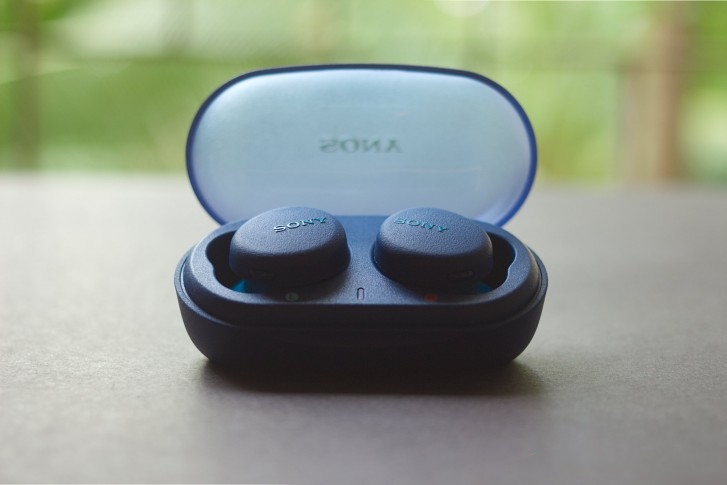
The WF-XB700 are a more affordable alternative to Sony’s popular but expensive WF-1000XM3 earphones. These do not include the active noise-canceling and some of the more advanced features of the WF-1000XM3 but have a more standard feature set with the addition of Extra Bass sound. At $130, the WF-XB700 are a full $100 cheaper than the WF-1000XM3 and more in line with the Samsung Galaxy Buds and the standard Apple AirPods.
While not the cheapest truly wireless earphones on the market, the Sony WF-XB700 could potentially be a good choice for someone looking for a quality product from a more reputable brand rather than picking something up from Amazon’s bargain bin. Let’s see how well they fare, especially against established rivals.
Design
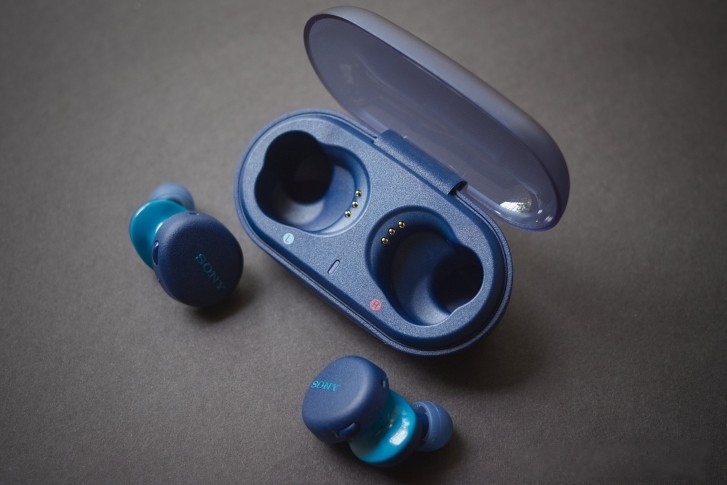
The WF-XB700 come in a now-common pill-shaped case. The case is a bit larger than what most truly wireless earphones have but the reason for that does become apparent later on when you take the earphones out.
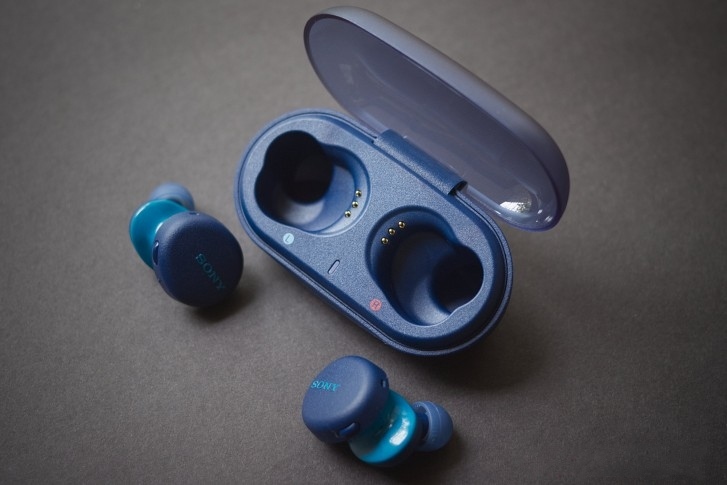
The case is finished in matte plastic and feels quite nice. The lid is translucent, which allows you to see the status LEDs for the case, and the individual earphones inside without opening it. Having said that, the LEDs for the case and earphones point in a different direction so you can’t always see them all at a glance from the same angle.
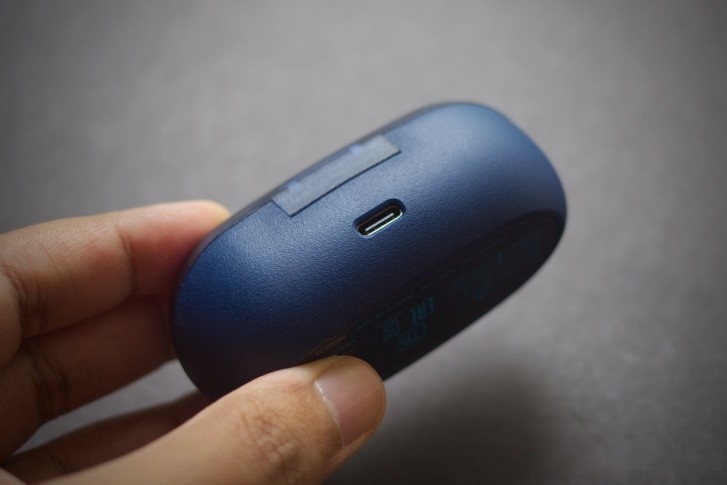
The back of the case has a USB-C connector for charging.
Opening up the lid, you notice that the case design is tilted forward, making the earphones angled towards you. The effect is similar to opening a case for a piece of jewelry but is likely done so you can see all the LEDs more clearly from outside when the lid is closed. But as we discussed before, that doesn’t quite work.
Before I get to the earphones themselves, I want to mention that the lid has quite a satisfying opening and closing mechanism. It’s clear Sony engineers paid some attention to the case design, and it is indeed quite a bit nicer than those you get with cheap truly wireless earphones.
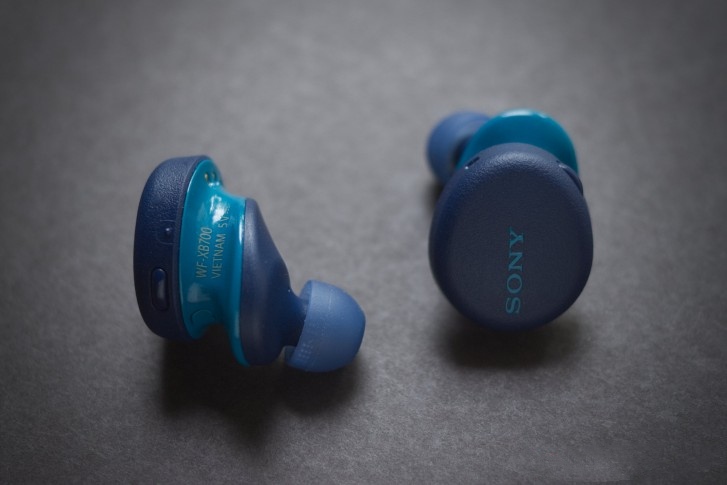
Now, on to the earphones. When you pull one of these out you realize why the case is so much taller than most other truly wireless earphone cases. The earphones seem massive at first and larger than what I had anticipated based on pictures. It’s an almost alien-looking enclosure, with a perfectly normal exterior and then all sorts of shapes and appendages bulging out of it. There are three layers to the design, the outer case, then a second layer that sits inside your outer ear, and then finally the part that goes in your ear.
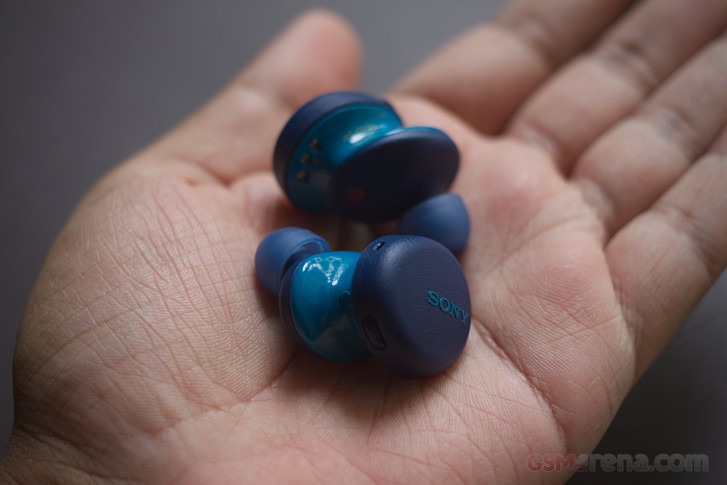
All of this gives the WF-XB700 earphones quite a unique appearance and at first, I wasn’t sure how this even goes in my ears. My initial assessment that the Sony logo on the outside would be horizontal once I wear them was wrong and the logo sits almost vertical once they are in your ears. Once you figure that out, putting them on is as easy as any other earphones.
Both the earphones have one button each for controlling all the functions. The list of functions seems excessive at first but as you use them you get used to it. The button on the left controls volume; you press to increase and press and hold to decrease. The button on the right controls the playback; press once to play/pause, twice to skip forward, thrice to skip back. If you press and hold it activates the voice assistant on your phone. Both the left and right buttons can be pressed to pick up/end calls.
I’ll say this about the buttons; Sony had the common sense to implement the buttons on the side of the earphones rather on top of them. This means you can press them without pressing the entire earphone deeper into your ears. The number of manufacturers who fail to grasp this basic design concept is baffling.
The size of the earphones is a bit large and they also stick out a fair bit out of your ears. This means you can’t comfortably wear them in bed. It’s also not particularly comfortable to wear them with a face mask, especially if you have smaller ears like mine that get pulled in by the elastic straps.
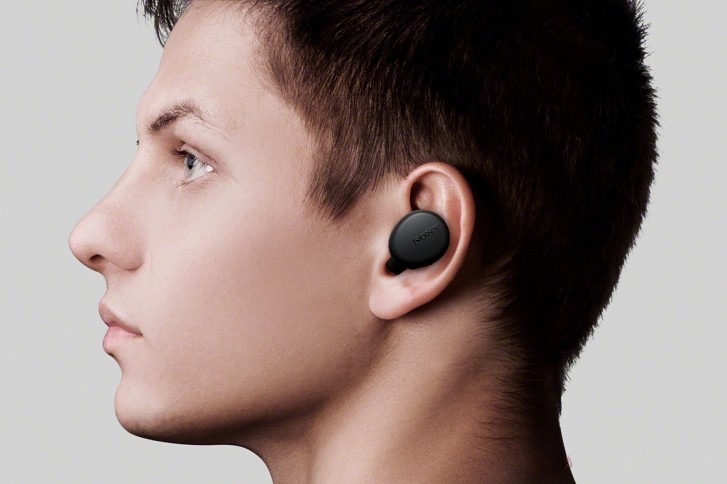
Another issue with the design of the WF-XB700 is that it seems to be held in place just by the ear tips inside your ears. While it never felt like they would fall out, due to the additional mass hanging out, the earphones tend to bounce in your ears when you walk or run. This is due to the shock that goes up through your heels when they hit the ground, which causes the body of the earphones to bounce as it’s only held in place at one point. This creates a small but noticeable vibration in your ears every time you walk on a hard surface that may or may not bother you.
The neat thing about the design of the WF-XB700 is that it is IPX4 rated for water resistance. This means you can wear them during workouts or in the rain without worrying about water or sweat damage. They are not, however, rated for use underwater. Also, the rating is just for the earphones and not the case.
Comfort
The WF-XB700 are a reasonably comfortable pair of earphones. The silicone ear tips are soft and the default size fits my ears perfectly. If that’s not the case for you, there are two additional sizes in the box.
However, for the reasons mentioned in the previous section, I wasn’t always happy with these earphones. The vibrations while walking were quite noticeable and not something I could ignore. It also seems that a part of the plastic molding sits against my ear in a particular way that for short durations isn’t noticeable at all but if I wear them for upwards of 30 minutes I do feel a strain around the entrance of the ear canal. This may be due to the earphones essentially using this region to anchor their entire weight instead of using things like fins that some other earphones use.
So for short, sedentary sessions, I was perfectly happy with the comfort of these earphones but I wouldn’t use these for extended sessions or running. However, comfort for in-ears can be quite subjective based on ear sizes so your mileage will vary.
Software and features
The WF-XB700 are not compatible with Sony’s Headphone Connect app. This means you can’t customize the sound, update the firmware or access any additional functions. You are pretty much limited to what you get out of the box and whatever your connected phone has to offer.
The WF-XB700 support Bluetooth 5.0, however, there is no multi-device pairing support. In terms of codecs, you are limited to SBC and AAC but as I often say in these reviews, what codecs you have has less of an impact on audio quality than how the codec is implemented and how the audio is coded, decoded and then processed.
The WF-XB700 lack NFC so any pairing has to be done manually. Out of the box, they are already in pairing mode so you are good to go. If you need to repair them, just press and hold buttons on both the earphones for seven seconds to put them into pairing mode.
The odd thing with the WF-XB700 is that announcements regarding connectivity and pairing often happen in just the left earphone even when both are in use. Both earphones will announce their individual battery status but for everything else that concerns them both, the announcement only happens in one ear. Not sure what the logic behind that is.
Performance
The Sony WF-XB700 are good-sounding pair of earphones. The sound has obviously been designed to accentuate the bass but the rest of the audio spectrum is surprisingly well-balanced. This is a departure from what we normally see on Sony Extra Bass Headphones that feature a lop-sided sound signature that makes it hard to notice anything else in the sound other than the bass.
Starting with the low-end, the WF-XB700 have perhaps one of the most restrained bass boosts I’ve heard in Sony’s history. Not shy of going all-out, Sony’s Extra Bass products often feature a bombastic bottom-end that overwhelms your eardrums. The WF-XB700 takes a more tasteful approach here, with a measured twist of the volume dial across the entire bass range. We are talking not much more than about 5dB boost across the range.
What this does is give a nice little kick to the low-end without blowing it out of proportions. Drums and other percussion instruments have a deeper thump to them without losing their essence. Electronic bass drops are just that bit more enjoyable without blowing your ears. There is a bit of rumble and boominess as a result of boosting frequencies that weren’t meant to be boosted but it isn’t too distracting here and depending on the content (movies, games) may even be enjoyable.
Perhaps the best thing about this measured bass response is that it doesn’t spill into the mid-range, which is surprisingly clean and natural. There is no annoying low-mid boost that just makes male voices sound artificial and annoying. On tracks that don’t have a ton of bass, you can still hear all the instruments and vocals clearly enough and it’s not the case where if the bass doesn’t show up, the party is canceled.
Battery
The WF-XB700 have a claimed continuous battery life of 9 hours. The case provides one additional charge for another 9 hours of use, so a combined 18 hours of battery life.
During my usual battery drain test, the WF-XB700 went on for about 9 and a half hours of continuous playback. That’s much longer than most truly wireless earphones in its class, including the Galaxy Buds and Apple AirPods, and close to the more expensive Galaxy Buds+. The combined 18 hours might not seem that impressive compared to other models but the WF-XB700 offers more of it continuously rather than splitting it up over multiple charges.
 Adi Techno World